There is one word that has been widely talked about following the Indonesian National Team’s victory in the FIFA ASEAN Cup 2026: King.
After Indonesia defeated Thailand through a dramatic penalty shootout and secured the ASEAN championship title, the term “King Indo” was widely used by netizens to celebrate the achievement. Emil Audero’s outstanding performance during the penalty shootout also helped make the term even more popular on social media.
From football, we turn to the world of seafood. There is another “King” worth getting to know: King Tilapia. Indeed, the two are not in the same arena. However, there is one interesting similarity: both have something that makes people pay extra attention.
Not Just the Name “King”
In the context of the Indonesian National Team, “King Indo” emerged as a form of appreciation after becoming the ASEAN champion. Meanwhile, in the seafood world, King Tilapia has more measurable standards.
King Tilapia is the highest tier in the Global Open Standard for Tilapia Quality, with assessments covering:
- Farming practices
- Fish size
- Processing quality
- Animal welfare
- Nutritional composition
- Culinary performance
So, if King Indo was born from achievements on the field, King Tilapia is built through quality standards from farming to the plate.
What Makes King Tilapia Different?
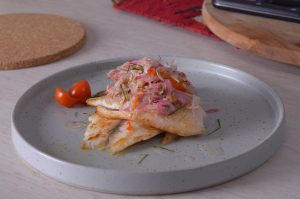
One of the main distinguishing features of King Tilapia is the size and characteristics of its fillets. King Tilapia is targeted to have a minimum mean weight of approximately 2.65 lb or 1.2 kg for whole round fish. This size allows for:
- Minimum loin of 106 grams / 3.8 oz
- Minimum fillet of 5 oz
- Minimum thickness of 19 mm
- Cooking yield of more than 85%
- Clean and mild taste
- Bright white color after cooking
These characteristics make King Tilapia attractive not only to consumers, but also to chefs, restaurants, foodservice operators, retailers, and seafood buyers who require ingredients with consistent specifications and performance.
Because in the Kitchen, Consistency Matters
For professional kitchens, choosing fish is not only about taste. There are several things that need to be considered:
- Size and thickness
Larger and thicker fillets or loins provide greater flexibility in determining portions and cooking techniques. - Yield
The better the yield obtained after cooking, the easier it is for businesses to calculate raw material usage. - Texture and taste
King Tilapia is developed with a firm texture and clean, mild flavour that is suitable for various culinary concepts. - Supply consistency
For foodservice businesses, predictable raw materials are just as important as good taste.
From King Indo to King Tilapia
Perhaps this is the interesting part of the wordplay “King Indo and King Tilapia.” King Indo earned its nickname after demonstrating a performance that brought Indonesia to become the ASEAN champion.
King Tilapia gets its name from standards designed to distinguish its quality from ordinary tilapia. The two certainly have different stories. But one thing remains the same:
A “King” always carries the expectation of delivering something more.
On the field, King Indo brings pride.
At the dining table, King Tilapia offers a seafood experience with quality, size, and culinary performance designed to meet modern needs.
So, after we cheer:
“King Indo!”
There is no harm in getting to know another “King”:
King Tilapia.
Because it turns out, being a King is not only about the name, but about what lies behind it.