In the seafood industry, tilapia serves a broad market with diverse needs. Some buyers look for cost-efficient ingredients for large-scale production, while others require more specific product specifications to meet menu standards and customer expectations.
Both needs are equally important. Commodity tilapia plays a role in meeting market demand that prioritizes flexibility and efficiency, while premium products such as King Tilapia offer differentiation through more clearly defined quality standards and product characteristics.
So, what actually distinguishes King Tilapia from commodity tilapia? To answer this question, we need to look beyond price or product names and examine quality standards, size, fillet thickness, and performance during processing.
1. Commodity and Premium: Two Approaches for Different Needs
In seafood trading, the term commodity generally refers to products that are widely traded and often compared based on price, volume, and basic specifications.
Commodity tilapia can be used for various purposes, from household consumption and restaurants to the food processing industry. These products continue to offer value as long as they meet the quality requirements and specifications buyers need.
Meanwhile, the premium approach focuses on product differentiation through specific characteristics and standards that are relevant to end users.
King Tilapia from Regal Springs Indonesia is developed using this approach. It occupies the highest tier in the Global Open Standard for Tilapia Quality, a quality framework consisting of four levels: King, Prime, Choice, and Base.
The standard covers several aspects, including farming practices, fish size, processing quality, fish welfare, nutritional composition, and culinary performance.
Therefore, the distinction does not mean that commodity tilapia is always lower in quality. The main difference is that King Tilapia follows a more clearly defined premium quality framework designed to support the needs of specific markets.
2. More Clearly Defined Quality Standards
One of the challenges in seafood procurement is ensuring that the offered specifications genuinely match operational requirements.
The species name alone is not enough to describe a product’s overall characteristics. Buyers still need to understand the product format, size, thickness, processing condition, and other quality requirements.
For commodity tilapia, specifications can vary depending on the producer, product format, and agreements with buyers. Commodity products with clearly defined specifications can also meet high quality requirements.
With King Tilapia, premium standards provide an additional reference for evaluating product characteristics and suitability for culinary applications.
For professional buyers, this standards-based approach can support supplier evaluations, purchasing specification development, and product testing before use in production.
In other words, King Tilapia’s added value lies in the standards used as a reference for evaluation, rather than simply in the premium label attached to its name.
3. Fillet Size and Thickness for Foodservice Needs
In restaurant and hotel operations, fillet size and thickness can affect portion planning, cooking techniques, and dish presentation.
Chefs serving fish as a main course may require cuts with specific dimensions to match recipe standards. Food manufacturers, meanwhile, may have different size requirements.
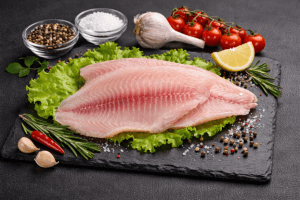
King Tilapia Loins have the following product specifications:
- Minimum weight of 106 grams per piece.
- Minimum thickness of 19 mm.
These specifications provide a reference for chefs and procurement teams when determining whether a product meets menu requirements.
Suitable thickness can support cooking process planning and dish presentation, particularly for menus where the fish cut is the main component on the plate.
On the other hand, commodity tilapia can still be the right choice for applications that require different sizes or cut formats. Smaller cuts, for example, may be suitable for menus with specific portion requirements or different processing needs.
Therefore, King Tilapia’s advantage in this context does not mean that every commodity tilapia fillet is smaller or thinner. Its advantage lies in having defined size and thickness specifications that can serve as a reference for specific requirements.
4. Yield: Connecting Specifications with Economic Value
Purchase price is an important factor in ingredient procurement. However, to understand the economic value of fish products, buyers also need to consider yield.
There are two types of yield to distinguish:
- Usable yield is the proportion of raw material that remains usable after preparation processes, such as trimming or removing unwanted parts.
- Cooking yield is the proportion of a product’s weight after cooking compared with its weight before cooking, based on the measurement method used.
Both provide different information about ingredient utilization.
King Tilapia Loins have a target cooking yield of more than 85% for fresh products or frozen products handled correctly according to the product standards.
For illustration, if 1 kg of loin achieves an 85% cooking yield, the product will weigh approximately 850 grams after cooking. This figure illustrates the stated target and does not guarantee the same actual results in every cooking process.
Actual results are still influenced by product condition, storage, thawing procedures, cooking techniques, and the targeted level of doneness.
Commodity tilapia can also achieve good yields when product quality, cut format, and handling are appropriate. Therefore, buyers should not assume that all commodity products have lower yields than King Tilapia.
A more objective comparison can be made by testing equivalent product formats under comparable initial conditions and cooking methods.
5. Product Consistency to Support Operations
In the foodservice business, consistency is an important consideration when selecting ingredients.
Restaurants need to ensure that the dishes they serve meet recipe standards. Procurement teams must also verify that delivered products comply with the agreed specifications.
Differences in ingredient size or thickness may require adjustments to preparation and cooking processes. Clear specifications therefore help align kitchen requirements with procurement processes.
King Tilapia offers product standards covering specific characteristics, giving buyers a reference for inspection and evaluation.
However, consistency is not determined by written standards alone. Buyers still need to evaluate delivered products, supplier documentation, and the compliance of each shipment with the agreed specifications.
Commodity tilapia can also meet consistency requirements when suppliers have appropriate specifications and quality control systems.
For buyers, the relevant distinction is therefore the level of specification required and how well the offered product meets those requirements.
6. Choose Based on Needs, Not Just Product Categories
Not every business requires premium specifications for every application. Conversely, not every requirement can be met simply by choosing the lowest purchase price.
Product selection should be tailored to the intended application, quality standards, and operating cost calculations.
The following provides a simple overview to support the evaluation process.
This comparison illustrates different approaches rather than suggesting that all commodity tilapia products have the same characteristics.
To make an informed decision, buyers can take the following steps:
- Determine the required product format and portion size.
- Review the product specifications offered by each supplier.
- Test usable yield and cooking yield using the same methods.
- Evaluate the final product quality and its suitability for the menu.
- Calculate ingredient costs per serving.
- Ensure the supplier can meet the agreed procurement requirements.
This approach helps buyers select products based on actual business needs.
7. King Tilapia as an Option for Premium Requirements
For buyers looking to develop menus with more clearly defined product standards, King Tilapia offers several relevant points of reference, from its quality standards to the specifications of King Tilapia Loins.
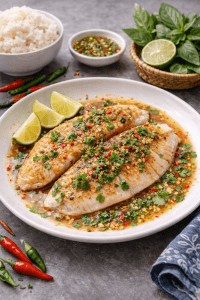
Its white flesh and relatively mild flavor also create opportunities for various dishes, from pan-seared and baked fish to other foodservice applications.
However, final suitability still needs to be assessed through product testing, recipe trials, and consideration of customer requirements. Not every menu needs the same specifications, and commodity tilapia can continue to meet a wide range of market needs.
King Tilapia can therefore be positioned as an option for buyers who require specific premium standards, while other tilapia products continue to play an important role in serving the broader market.
For more information about the product and its quality approach, visit the King Tilapia page from Regal Springs Indonesia.
Meeting Different Needs
King Tilapia and commodity tilapia both have a role in the seafood industry. Each can serve different needs depending on product specifications, intended applications, and the standards established by buyers.
King Tilapia’s distinction lies in its more clearly defined premium quality approach, including product standards and King Tilapia Loins specifications: a minimum weight of 106 grams per piece, a minimum thickness of 19 mm, and a target cooking yield of more than 85% when handled appropriately.
For restaurants, hotels, distributors, and food processing businesses, these specifications can serve as a reference for assessing product suitability for operational requirements.
Ultimately, choosing King Tilapia or commodity tilapia is not about deciding which product is always better. What matters most is understanding market needs, objectively evaluating specifications, and selecting the product that offers the best value for the intended business purpose.